★★★★★
★★★★★
Verified Buyer
The quality and speed of delivery impressed me. I'll be shopping here again.
Verwendung: Dieses Produkt ist ausschließlich für Forschungszwecke bestimmt.
Alle Produktinformationen auf dieser Website dienen ausschließlich Bildungszwecken. Jede Form der Einbringung in den Körper von Menschen oder Tieren ist gesetzlich streng verboten. Dieses Produkt darf nur von zugelassenen und qualifizierten Fachleuten gehandhabt werden. Es ist kein Arzneimittel, Lebensmittel oder Kosmetikum und darf nicht als solches gekennzeichnet, verwendet oder falsch etikettiert werden.
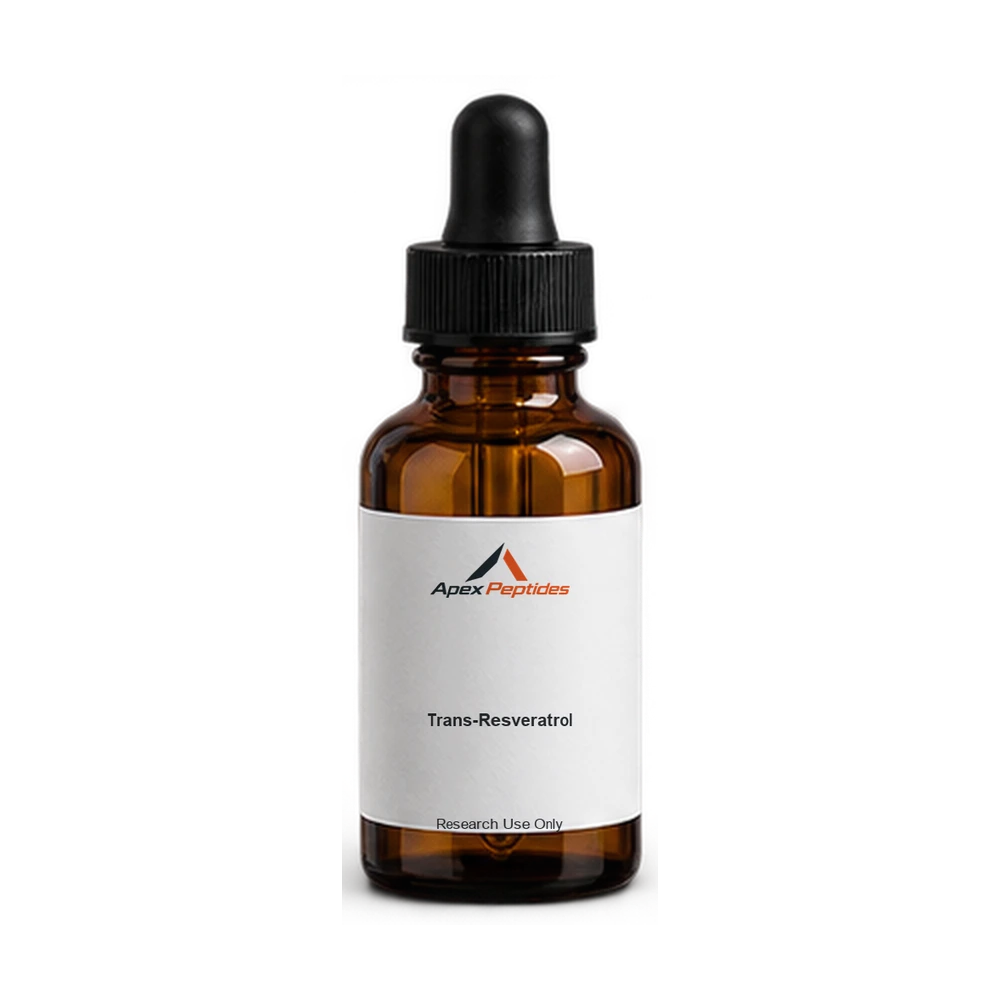
Trans-Resveratrol is a naturally occurring polyphenolic compound belonging to the stilbene class of phytochemicals. It is the trans geometric isomer of resveratrol, characterized by a planar molecular configuration that contributes to its chemical stability and biological interaction potential in biochemical systems.
Während der Umstellung unserer Verpackung erhalten Sie möglicherweise Produkte mit dem bisherigen oder dem neuen Etikett. Formulierung, Reinheit und Qualität bleiben nach unseren Standards genau gleich.
-25% auf alles – bis 31. Oktober
25% auf reguläre Preise statt anderer Angebote. Nur mit dem Krypto-Zahlungsrabatt kombinierbar.
Jede Charge wird auf Reinheit, Wirksamkeit und Qualität geprüft.
Laborergebnisse ansehen →Trans-Resveratrol is a naturally occurring polyphenolic compound belonging to the stilbene class of phytochemicals. It is the trans geometric isomer of resveratrol, characterized by a planar molecular configuration that contributes to its chemical stability and biological interaction potential in biochemical systems.
Trans-resveratrol is commonly identified in plant-derived sources such as grape skins and certain botanical species, where it functions as a phytoalexin involved in plant defense mechanisms. In laboratory environments, it is used as an investigational compound in biochemical and molecular research.
Scientists examine this molecule to better understand polyphenol-mediated signaling pathways, oxidative stress responses, and intracellular regulatory mechanisms. Because of its well-defined structure and redox-active functional groups, trans-resveratrol is frequently utilized in in vitro studies and experimental research models exploring cellular signaling, enzyme regulation, and transcriptional pathway modulation.
Due to the presence of multiple phenolic groups, trans-resveratrol can participate in redox-related biochemical interactions. In experimental models, researchers study its influence on cellular pathways involved in the regulation of reactive oxygen species (ROS) and redox-sensitive signaling cascades.
Laboratory investigations have examined trans-resveratrol in relation to enzyme-mediated regulatory pathways, including interactions with enzymes involved in cellular metabolic signaling. These pathways often include regulatory proteins associated with energy metabolism and intracellular stress-response signaling.
Within controlled research environments, trans-resveratrol is studied for its potential role in modulating signaling pathways such as:
These pathways are widely investigated in experimental models examining cellular stress signaling, metabolic regulation, and intracellular communication mechanisms.
In in vitro experimental models, trans-resveratrol is commonly used to investigate cellular responses to oxidative stress and to study mechanisms that regulate redox-sensitive signaling pathways.
Researchers incorporate trans-resveratrol into experimental metabolic research models to analyze pathways associated with cellular energy regulation, enzyme activity, and metabolic signaling networks.
Laboratory studies frequently utilize trans-resveratrol to examine transcription factor activation and gene expression regulation in cell-based research systems. These experiments help characterize how polyphenolic molecules influence intracellular signaling cascades.
Trans-resveratrol is also used in structure-activity relationship (SAR) studies that investigate how polyphenolic compounds interact with enzymes, receptors, and regulatory proteins. Such research contributes to a deeper understanding of molecular binding dynamics and biochemical pathway modulation.
In preclinical research models, trans-resveratrol may be used to explore biochemical pathways related to oxidative signaling, metabolic regulation, and intracellular communication mechanisms within controlled laboratory conditions.
| Compound Name | Trans-Resveratrol |
|---|---|
| CAS Number | 501-36-0 |
| Molecular Formula | C14H12O3 |
| Molecular Weight | 228.24 g/mol |
| Chemical Classification | Stilbene polyphenol |
| IUPAC Name | 5-[(E)-2-(4-hydroxyphenyl)ethenyl]benzene-1,3-diol |
| Structural Features | Two phenolic rings connected by an ethylene bridge |
The quality and speed of delivery impressed me. I'll be shopping here again.
Highly satisfied with the support team and purity exceeded my expectations. A trustworthy supplier. My laboratory research results exceeded expectations.
Very happy with the ordering process and quality was great and dispatch was incredibly fast. Reordering next week. My test results are great.
Results from my tests exceeded all expectations. Highly recommend the secure packaging and happy with the quality of this compound. Excellent all-round service.
My laboratory research results exceeded expectations. Highly satisfied with the fast turnaround times, quality is stellar. Reordering next week.
GREAT PRODUCT, FAST DELIVERY. AAA+++