★★★★★
★★★★★
Verified Buyer
Great. I've purchased numerous times.
Verwendung: Dieses Produkt ist ausschließlich für Forschungszwecke bestimmt.
Alle Produktinformationen auf dieser Website dienen ausschließlich Bildungszwecken. Jede Form der Einbringung in den Körper von Menschen oder Tieren ist gesetzlich streng verboten. Dieses Produkt darf nur von zugelassenen und qualifizierten Fachleuten gehandhabt werden. Es ist kein Arzneimittel, Lebensmittel oder Kosmetikum und darf nicht als solches gekennzeichnet, verwendet oder falsch etikettiert werden.
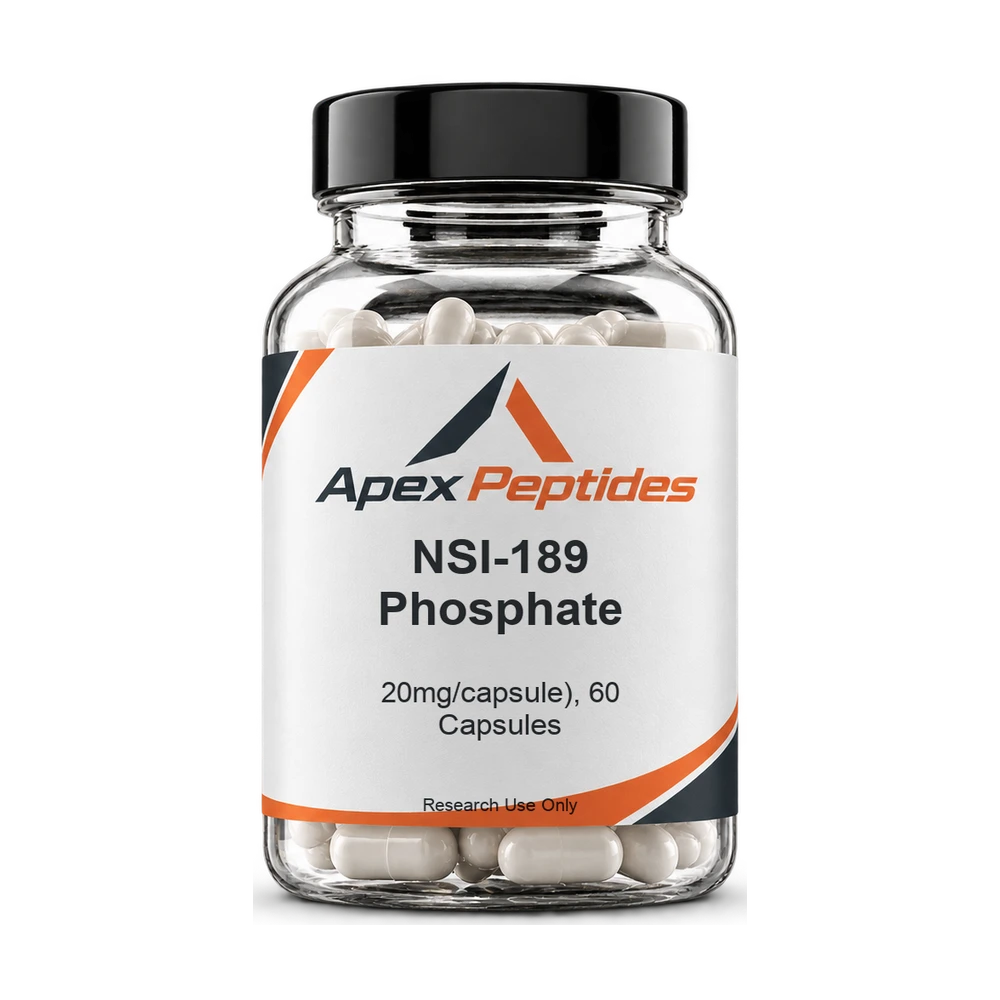
NSI-189 phosphate is a synthetic benzylpiperazine-aminopyridine derivative investigated for its effects on neural progenitor cell biology and hippocampal neurogenesis pathways.
Während der Umstellung unserer Verpackung erhalten Sie möglicherweise Produkte mit dem bisherigen oder dem neuen Etikett. Formulierung, Reinheit und Qualität bleiben nach unseren Standards genau gleich.
-25% auf alles – bis 31. Oktober
25% auf reguläre Preise statt anderer Angebote. Nur mit dem Krypto-Zahlungsrabatt kombinierbar.
Jede Charge wird auf Reinheit, Wirksamkeit und Qualität geprüft.
Laborergebnisse ansehen →NSI-189 phosphate is a synthetic benzylpiperazine-aminopyridine derivative investigated for its effects on neural progenitor cell biology and hippocampal neurogenesis pathways.
Unlike compounds that primarily modulate monoamine transporters or neurotransmitter receptors, NSI-189 has been studied for its reported ability to promote proliferation, differentiation, and survival of neural progenitor cells in experimental models.
Research has focused on its effects on hippocampal cell populations, neurogenic signalling pathways, neuronal maturation processes, and structural plasticity mechanisms.
Experimental applications include neural progenitor proliferation assays, neurogenesis pathway investigations, cell differentiation studies, hippocampal tissue modelling, and structure-activity relationship (SAR) research within the benzylpiperazine-aminopyridine compound class.
| Chemical Formula | C22H33N4O5P |
|---|---|
| Synonyms | NSI-189 phosphate 1270138-41-4, UNII-HX0VO60T62, HX0VO60T62, NSI189 Phosphate |
| Molar Mass | 464.5 g/mol |
| CAS Number | 1270138-41-4 |
| PubChem CID | 50922680 |
| Total Compound Content | 1200mg (20mg per capsule) |
| Shelf Life | 36 months |
Results refer to the tested sample. Check the batch and date in the report.
Common experimental approaches include in vitro proliferation assays using neural progenitor cell cultures, with proliferation quantified through markers such as BrdU incorporation or Ki-67 expression. Differentiation studies often monitor changes in neuronal lineage markers, including doublecortin (DCX) and NeuN, over extended culture periods.
Concentration-response experiments are frequently performed to characterize proliferative activity and compare responses across different experimental conditions.
Neurogenesis research typically utilizes immunohistochemical analysis of proliferation markers such as Ki-67 and BrdU, together with immature neuronal markers including doublecortin (DCX). Quantification is commonly performed through stereological cell counting, image-based analysis, and biomarker expression profiling.
Additional assessments may include volumetric imaging and histological measurements to evaluate structural changes associated with prolonged experimental exposure.
NSI-189 phosphate is investigated primarily for its reported effects on progenitor-cell proliferation and neurogenesis-associated signalling pathways rather than direct interaction with monoamine transporters or neurotransmitter receptors.
Mechanistic studies often employ receptor antagonists or pathway-specific inhibitors to determine whether observed cellular effects persist independently of monoaminergic signalling. This approach helps distinguish progenitor-cell-directed activity from secondary effects associated with neurotransmitter-dependent mechanisms.
Great. I've purchased numerous times.
This product met all of mine expectations. Thank you.
order #436173M I ordered over a week ago and still haven’t received a tracking number. 0 customer support and starting to feel scammed but I see all these reviews so I’m confused.
As described. All is great, product, shipping and service.
Our research results have been outstanding. Highly recommend the ordering process and the chemical quality is top notch. Highly satisfied customer.